Working With Your Tattoo Artist: Collaboration Etiquette, AI Drafts & Who Owns the Design
By Alice Tattoos · Tattoo Guide · Nov 1, 2026 · 7 min read
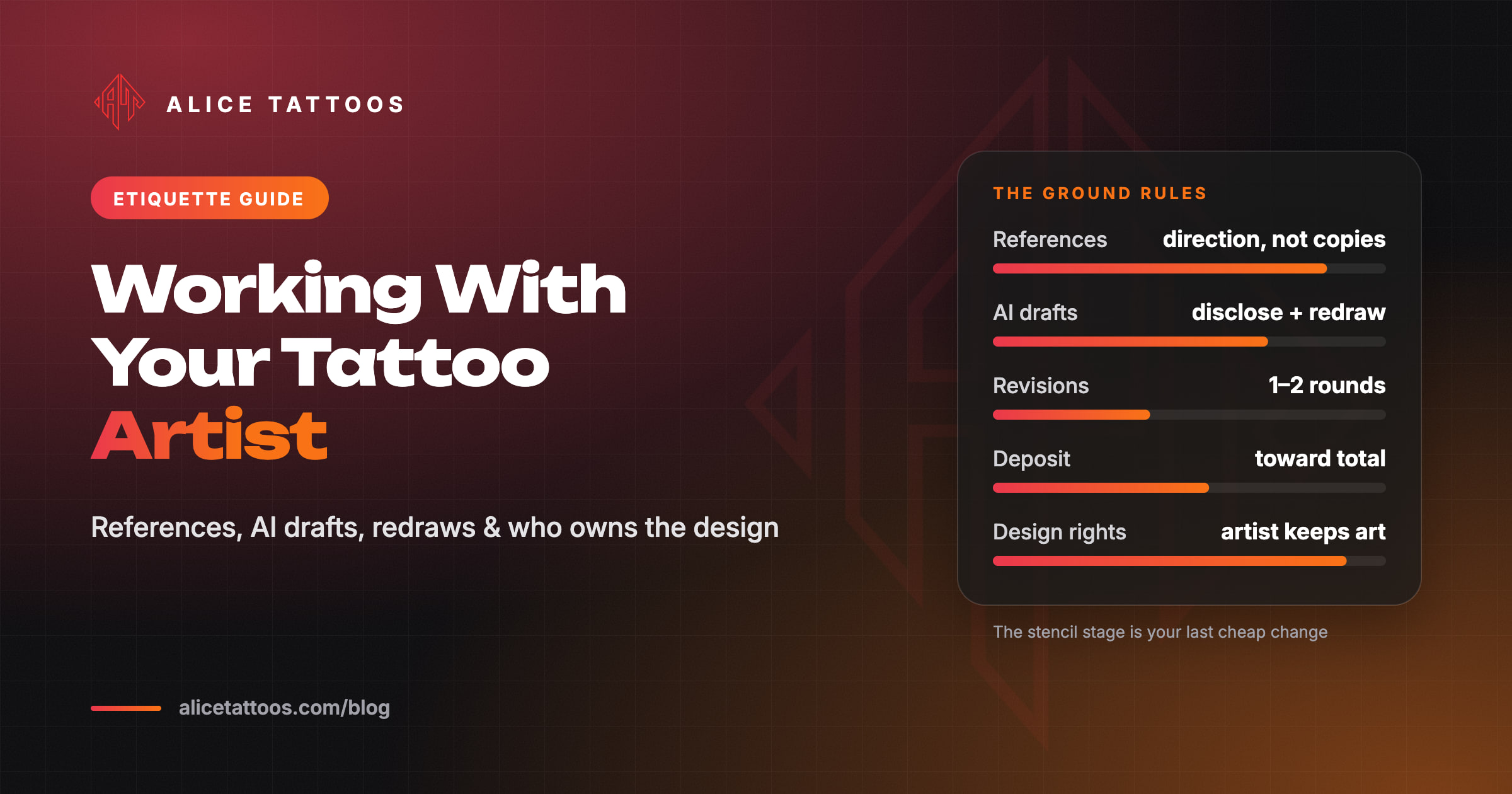
Short answer: a good tattoo collaboration works like a commission, not a purchase. You bring the concept and honest feedback; the artist brings the design and the craft. The etiquette is simple once you see it: share references for direction rather than demanding copies, disclose AI-generated drafts and expect the artist to redraw them, pay the deposit without haggling, speak up at the stencil stage, and understand that the artist usually keeps the rights to the artwork even though it's on your skin.
Key takeaways
- References are for direction, not duplication — never ask an artist to copy another artist's tattoo.
- AI drafts are a legitimate concept tool, but they're a moodboard, not a stencil. Say it's AI, and let the artist interpret it.
- Copyright usually stays with the artist — you own the tattoo on your body, not the design. Don't take one artist's drawing to another shop.
- One to two revision rounds is normal. The stencil on your skin is your last cheap moment to change anything.
- Deposits, punctuality, and no haggling are the baseline. Healed photos and proper credit are the thank-you.
Collaboration is a commission, not a transaction
The best tattoos happen when both sides treat the project as shared work. The collector's job is clarity — knowing what they want, communicating it early, and trusting the specialist they chose. The artist's job is honesty — about what will work on skin, what it will cost, and how it will age. Most etiquette blowups trace back to one side forgetting this is a two-way deal.
| Situation | Good collaboration looks like | The red flag |
|---|---|---|
| Sharing references | A handful of images plus what you like about each one | "Copy this exact tattoo off someone else's Instagram" |
| AI drafts | "Here's a concept I generated — what would you do with it?" | Presenting raw AI output as finished art, or hiding that it's AI |
| The drawing | One or two focused rounds of consolidated feedback | Endless tweaks, redesign-by-committee, asking for the file |
| Money | Deposit paid promptly; quote accepted or politely declined | Haggling, "mates rates," no-showing on the day |
| Tattoo day | Speaking up at the stencil stage | Silence in the chair, complaints afterward |
| Afterward | Healed photos, artist credit, honest review | Shopping their custom drawing around to cheaper artists |
Bringing references the right way
Artists want references — they shorten the distance between what's in your head and what ends up on paper. The trick is bringing them as a brief, not a blueprint. Three to five images beats forty. Say what you like about each: "the linework in this one, the placement flow in that one, this level of detail." That tells the artist far more than a folder of fifty unrelated tattoos.
The hard line: a photo of another artist's finished tattoo with "can you do this" is the request that makes artists wince. That piece was drawn for a specific person's body by a specific artist — copying it is both an artistic insult and, in many jurisdictions, a copyright problem. What you can ask for is an original take on the same concept: "I love the idea of a moth and moon in this style — what would your version look like?" Picking an artist whose existing work already matches your taste — our 10-point checklist for choosing a tattoo artist walks through that vetting — removes most of the friction before it starts.
The AI-design question
AI-generated concepts have quietly become normal in consults, and most artists treat them like any other reference — useful for pinning down what a client means by "flowing" or "ornamental." But there's a right way and a wrong way to bring one.
The right way: say upfront that it's AI-generated, and frame it as a starting point. "I generated this in an AI tool — it's the direction I'm imagining, what would you keep and what would you change?" gives the artist a clear brief and full creative ownership of the final design.
The wrong way: handing over a raw AI file and expecting it traced onto skin. AI images routinely contain things that can't be tattooed — linework too fine to hold, shading that will blur to mud in two years, anatomy that doesn't survive wrapping around a real arm. The artist's redraw isn't a downgrade; it's the step that makes the idea tattooable. And be fair about it: a minority of artists decline AI references entirely, which is their call. Our guide to going from AI design to a real tattoo covers the full workflow, and the AI design studio is a fast way to generate those concept references before you ever message anyone.
Who actually owns the design
This is the part of the ethics conversation most people get wrong. In most countries, copyright in a tattoo design belongs to the artist who drew it, not the person wearing it. As the Arts Law Centre of Australia puts it, the default owner is whoever fixed the design in material form — the artist's line drawing or the freehand on your skin. You own your tattoo; they own the artwork it came from. Paying for the tattoo doesn't transfer the copyright any more than buying a painting transfers the artist's right to their composition.
What that means in practice:
- Don't take artist A's custom drawing to artist B because B is cheaper or has a sooner slot. That's the single most disrespectful move in the collaboration — and it's why many artists only reveal drawings on tattoo day or watermark previews.
- Flash is different. Flash sheets are designed to be tattooed repeatedly — that's their whole point. Custom work is drawn for you; it lives on you; it isn't a file you own.
- Posting photos is fine — your skin, your photos. Reposting their drawing for other artists to copy is not.
Money: deposits, quotes, and the no-haggle rule
The deposit isn't a negotiating opener — it's payment for drawing time and a hold on your slot, usually deducted from the final price and forfeited if you no-show. When a quote lands above budget, the respectful move is shrinking the scope ("what would this look like as a smaller piece?"), not asking for a discount. Custom tattooing is skilled, unrepeatable labor priced by the hour; our 2026 tattoo price guide breaks down where those numbers come from, and the tipping guide covers what goes on top.
Speaking up before it's permanent
Revisions at the drawing stage are normal — one or two rounds, consolidated into a single message, is the professional norm. A complete change of direction may mean a new drawing fee, which is fair: that was another session of work.
But the moment that matters most is stencil placement on your skin. This is your last cheap opportunity to change anything — position, size, rotation, even the decision itself. "Can we try it a little higher?" takes thirty seconds. Living with it, or paying for a cover-up or laser removal, takes years. Any artist worth booking would rather move a stencil three times than tattoo someone who's quietly unsure. Silence in the chair followed by a bad review afterward helps no one.
The artist's side of the deal
Ethics run both directions. A collaborating artist owes you honest portfolios — including healed work, not just fresh-day shots — realistic timelines, transparent deposit and cancellation terms, and a workspace you'd trust with an open wound. They owe their peers too: a professional doesn't trace another living artist's custom designs, doesn't poach clients mid-project, and doesn't promise a style they can't execute. If an artist claims they can do realism, fine-line, traditional, and lettering all at a master level from a six-month-old portfolio, that's the red flag. And their obligation doesn't end when you leave — pointing you at a real aftercare routine (and tools like the Healing Hub for tracking it) is part of the job.
After the needle stops
The collaboration continues for weeks. Send a healed photo — artists genuinely want them, because healed work is their real portfolio. Credit them when you post: a tag costs nothing and drives their bookings. Check their touch-up policy before assuming anything is owed; most offer one within a window, though hands, fingers, and feet are often excluded. And if the piece worked out, the strongest currency in tattooing is still a referral.
Putting it into practice
The whole flow in order: develop your concept — the AI studio is good for exploring direction and generating reference material — then find artists whose portfolios match the style on the tattoo directory. Message them with the idea, the placement, and your references (flagged honestly if any are AI). Book the consult, pay the deposit, give consolidated feedback on the drawing, and speak up at the stencil. After that, the hardest part is just the healing.
Is it rude to ask a tattoo artist to change their design?
Not at all — it's expected. One or two revision rounds is the norm for custom work. What artists find difficult is vague or scattered feedback ("I don't know, something's off" across six messages). Consolidate your thoughts into one clear list, be specific about what isn't working, and trust them on technical constraints like line spacing and sizing.
Can I bring an AI-generated design to a tattoo artist?
Yes, as a concept reference — say that it's AI up front and frame it as a starting point, not finished art. Expect the artist to redraw it: AI images often include linework too fine to hold or shading that won't age. A small number of artists decline AI references entirely, which is their right.
Who owns a custom tattoo design?
Usually the artist. Copyright defaults to whoever created the artwork, and paying for the tattoo doesn't transfer it. You own the tattoo on your skin — you can photograph it and post it — but the drawing itself is the artist's intellectual property. Taking their custom design to another shop is considered a serious breach of trust.
How many revisions can I ask for on a tattoo drawing?
One to two rounds is the standard expectation. Tweaks to details, sizing, and elements are normal; a total change of concept is effectively a new drawing and may come with a new drawing fee. If the first draft is nowhere near your vision, that's usually a sign the artist's style isn't the right match rather than a fixable problem.
Is it okay to get the same tattoo as someone else?
Depends on the design. Flash — designs drawn specifically to be repeated — is fair game; that's what it's for. Someone's custom piece is not. If you love a tattoo you saw, bring it as a reference and ask your artist for an original design in the same spirit. You'll end up with something better anyway: a version drawn for your body and your placement.