How to Choose a Tattoo Artist: A 10-Point Checklist
By Alice Tattoos · Tattoo Guide · Feb 16, 2026 · 6 min read
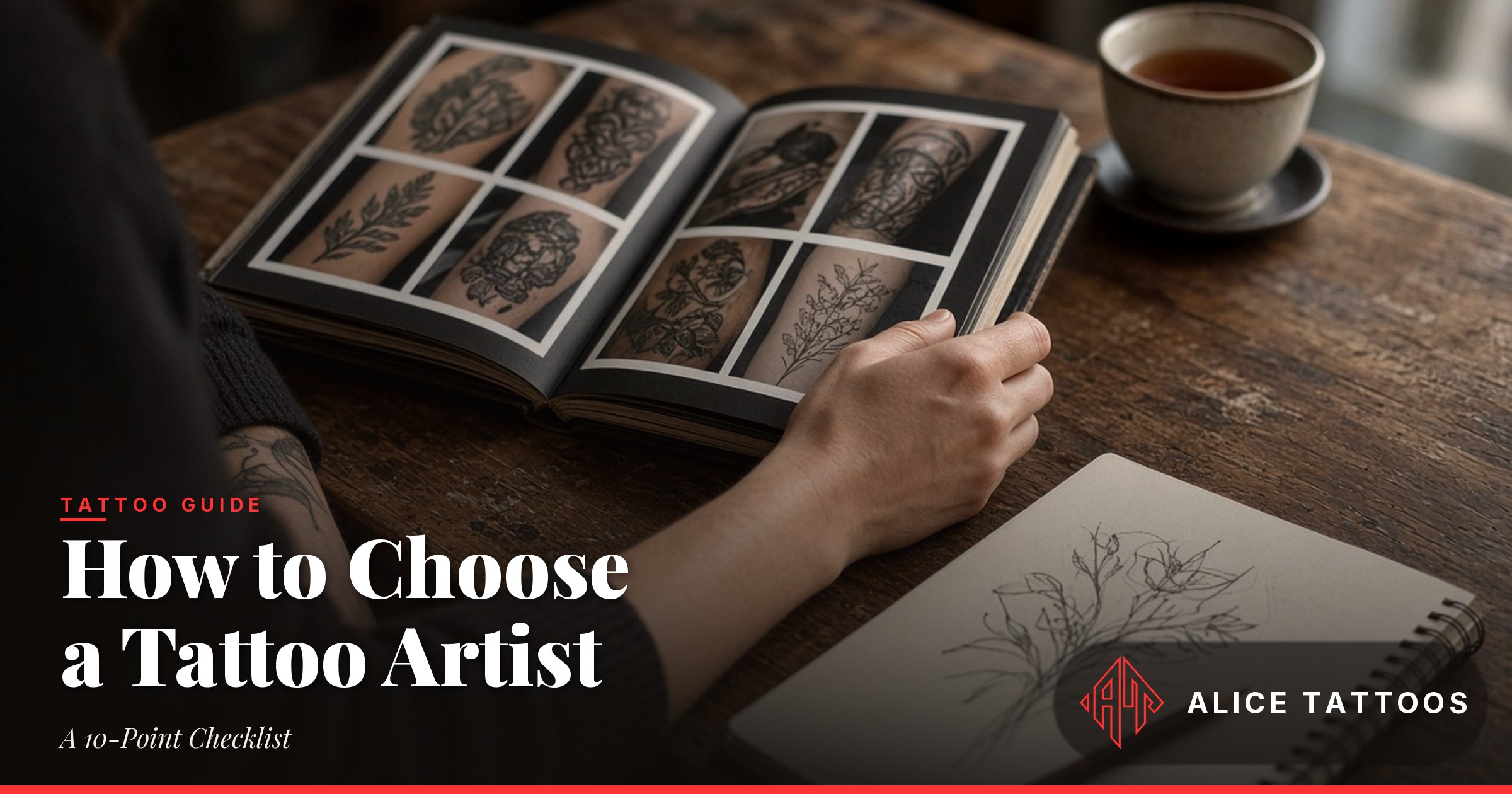
Short answer: choose a tattoo artist who specializes in the style you want and whose healed work looks clean and consistent. Make sure they work in a licensed, visibly hygienic studio and communicate clearly about price, deposits, and design changes. Price and distance matter, but they should be the last filters, not the first. Here's a 10-point checklist, the questions to ask, and the red flags that mean you should keep looking.
Key takeaways
- Style first. A great realism artist isn't automatically a great fine-line or traditional artist.
- Healed photos beat fresh photos. Fresh tattoos look good under ring lights. Healed work shows the real skill.
- Hygiene isn't negotiable: single-use needles opened in front of you, wrapped surfaces, fresh gloves.
- A good artist pushes back on designs that won't age well. That's a green flag, not rudeness.
The 10-point tattoo artist checklist
- They specialize in your style. Their portfolio should be mostly the style you want, not one example among fifty.
- Their lines are consistent. Zoom in on photos. Lines should be smooth and even, with no wobble, and circles should be round.
- You can see healed work, ideally months or years old, not just pieces photographed fresh off the table.
- They've done your size and placement. A tiny fine-line piece on a finger is a different skill from a full back piece.
- The studio is licensed wherever your local rules require it, and the license is easy to find. Requirements vary by country, state, and city.
- The hygiene is visibly good: a clean workstation, barrier film on surfaces and the machine, gloves changed whenever they touch something non-sterile, and needles and cartridges opened from sealed packaging.
- Their pricing is clear. They tell you whether it's hourly, flat, or a day rate, plus the deposit amount and what happens to it if you reschedule.
- They communicate. They answer questions, explain their process, and tell you what to expect.
- They give honest design feedback, like "this needs to be bigger" or "that detail will blur". It shows they care how it heals.
- You feel comfortable. You'll be in a chair with this person for hours. Trust your gut.
Why healed work matters so much
A fresh tattoo is sharp, saturated, and slightly swollen, and photo filters make it look even better. After 4–8 weeks the skin settles. Weak lines show wobble, blowouts (ink spreading under the skin) appear as blurry halos, and patchy color shows up. Healed photos are the best evidence of an artist's technique.
On Alice Tattoos, artist profiles include a Healed Journeys tab next to the regular portfolio. It shows real healing journeys that clients logged in the Healing Hub, so you can see how an artist's work actually settles over weeks.
Questions to ask before booking
- "How much of your work is in this style?"
- "Can I see healed photos of similar pieces?"
- "Is this size right for this placement, and how will it age?"
- "Do you price this flat or hourly, and roughly how many hours?"
- "How much is the deposit, is it deducted from the final price, and what's your rescheduling policy?"
- "Will I see the design before the appointment, and how many revisions are included?"
- "Do you offer a free touch-up, and within what time frame?"
Not sure about costs? Our guide to how much a tattoo costs breaks down hourly rates, minimums, and deposits, and the tipping guide covers what to add on top.
Red flags: when to walk away
- No healed work anywhere, only fresh, heavily edited photos.
- Needles or cartridges already open, or reused equipment that isn't single-use.
- Unwrapped surfaces, or gloves that touch phones and door handles and go straight back to your skin.
- They'll tattoo you while you're drunk, or they rush you through the consent form.
- Pressure to decide on the spot, pay cash only, or "book today for a discount".
- They agree to anything without any feedback, especially very small, very detailed designs.
- Dismissive answers about aftercare, or none at all.
Specialist, generalist, or apprentice?
Specialists (realism, Japanese, fine line, blackwork, traditional, script) are the best choice for detailed or style-specific pieces, and they often have waitlists. Experienced generalists are great for simple flash, lettering, and small first tattoos. Apprentices in reputable shops can be a good value for simple designs, since they work under supervision. Just set your expectations and look at their healed work too.
Look out for guest spots as well. Many in-demand artists travel and tattoo for a few days in other cities, which is a chance to get work from someone you'd otherwise have to fly to see.
How to find and compare artists on Alice Tattoos
- Get clear on your idea first. Explore concepts in the AI design studio and preview them on your body with the try-on tool. Knowing the style and size you want makes it obvious which portfolios to look for.
- Browse the tattoo directory by location or on the map. Cards show pricing when the artist publishes it.
- Open profiles to compare portfolios, flash designs, the Healed Journeys tab, deposit policy, and booking forms.
- Message your top two or three with your size, placement, style, and references, then book with the artist whose answer gives you the most confidence.
Once it's done, protect your choice with proper aftercare. Our day-by-day aftercare guide walks you through the first month.
Frequently asked questions
How do I know if a tattoo artist is good?
A good tattoo artist has a portfolio focused on your style, consistent and smooth linework, and plenty of healed photos. They also work in a licensed, visibly hygienic studio and give honest feedback about size, placement, and longevity.
Should I choose a tattoo artist based on price?
Price should be one of the last filters. Choose based on style specialty, healed work, and hygiene first, then pick the best artist within your budget. Fixing or covering a bad tattoo costs far more than paying for quality the first time.
What questions should I ask a tattoo artist before booking?
Ask how much of their work is in your style, whether you can see healed examples, whether your size and placement will age well, how pricing and deposits work, how revisions are handled, and what their touch-up policy is.
What are red flags at a tattoo shop?
Red flags include needles that aren't opened in front of you, unwrapped surfaces, gloves that aren't changed, no healed work in the portfolio, pressure to pay cash or decide immediately, and a willingness to tattoo intoxicated clients.
Is it rude to ask a tattoo artist for healed photos?
No. Professional artists expect it and are usually proud to show healed work. It's one of the most useful questions you can ask.
Is it OK to get tattooed by an apprentice?
Yes, for simple designs at a reputable shop where the apprentice is supervised. Apprentices often charge less. Review their healed work and save complex, detailed pieces for an experienced specialist.