Global Tattoo Trends 2026: What Different Cultures Are Bringing to the Ink Table
By Alice Tattoos · Tattoo Trends · Oct 25, 2026 · 8 min read
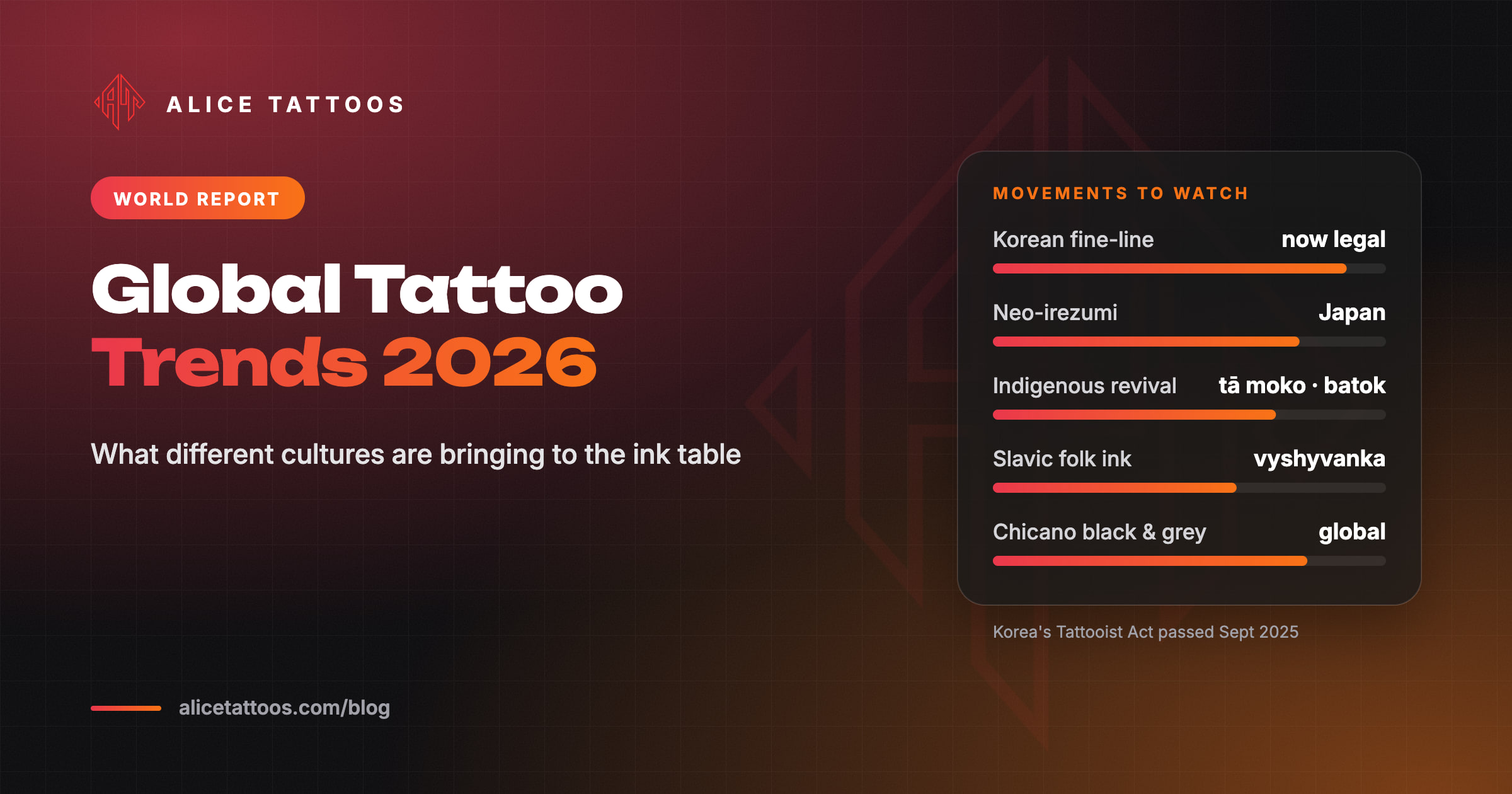
Short answer: the biggest tattoo story of 2026 isn't a single style — it's a wave of cultural movements arriving at once. South Korea legalized professional tattooing in September 2025 after a 33-year ban, Indigenous traditions from Māori tā moko to Filipino batok are being reclaimed by a new generation, and diaspora artists are fusing heritage motifs with modern technique. The styles surging hardest right now — Korean fine-line, neo-irezumi, Slavic folk, Chicano black-and-grey — each carry their own history, and their own rules for wearing them well.
Key takeaways
- Korea's Tattooist Act ended the requirement that tattooists hold a medical license — expect Seoul's influential fine-line scene to go fully mainstream through 2027.
- The fastest-growing work is heritage-driven: neo-irezumi, Indigenous revival tattoos, Slavic folk geometry, Chicano black-and-grey, Amazigh symbols, and mehndi-inspired ornament.
- Some marks are sacred or identity-bound — tā moko, Sak Yant, tribal rank symbols. The respectful path is a lineage artist and the right design category, not a screenshot.
- Bold-line traditions age better than ultra-fine micro work. Factor healing into the style you choose before you book.
The 2026 global tattoo map
These are the cultural movements showing up most in artists' books and collectors' requests this year. Each row covers where it came from, what it looks like, and what to check before you wear it.
| Movement | Roots | Signature look | Wearing it well |
|---|---|---|---|
| Korean fine-line & micro | Seoul's (formerly underground) scene | Hairline strokes, tiny illustrative pieces, delicate script | Low sensitivity — it's a technique, not a claim. Prioritize artists whose healed lines stay crisp. |
| Neo-irezumi | Japan | Koi, dragons, peonies and oni remixed in single-needle and illustrative styles | Learn the motifs — they carry specific meanings, and traditional composition flows with the body's musculature. |
| Indigenous revival | Aotearoa, Philippines, the Arctic | Tā moko, kirituhi, batok, Inuit kakiniit | High sensitivity — these marks are genealogical. Work with artists of that lineage and use the non-sacred category. |
| Slavic folk ink | Ukraine, Poland, the Balkans | Vyshyvanka embroidery geometry, papercut florals, wheat and poppy motifs | Medium — folk art is broadly shareable, but wartime identity symbols mean more than decoration. |
| Chicano black-and-grey | Mexican-American Los Angeles | Soft grey shading, ornate script, religious iconography | Medium — the style went global; sacred imagery like the Virgin of Guadalupe still carries weight. |
| Amazigh symbols & Arabic calligraphy | North Africa, Middle East | Geometric Amazigh marks, flowing fine-line script | Medium — some symbols denote tribal identity; get script verified by someone fluent. |
| West & Southern African symbols | Ghana, Nigeria, South Africa and beyond | Adinkra symbols, scarification-inspired linework, bold geometric bands | Medium — individual Adinkra symbols have specific meanings. Pick the concept before the graphic. |
| Mehndi ornament & sacred geometry | South & Southeast Asia | Henna-style wraps, mandalas, dotwork sleeves | Medium-high — deity imagery and Thai Sak Yant are religious, not decorative; placement matters. |
South Korea: fine-line goes legal — and global
For 33 years, South Korea was the only industrialized country where giving a tattoo required a medical license, after a 1992 Supreme Court ruling classified tattooing as a medical act. The scene thrived anyway, underground — and quietly shaped what the rest of the world asks for. On September 25, 2025, the National Assembly passed the Tattooist Act in a 195–0 vote, creating a real licensing system. The law takes full effect after a two-year transition, with existing artists working under temporary registration while they sit licensing exams.
Why it matters everywhere else: Korean artists effectively invented the modern fine-line and micro-tattoo aesthetic — hairline strokes, tiny illustrative pieces, delicate script — much of it perfected in unlicensed studios promoted only through social media. Legal recognition means open studios, international guest spots, and formal training. Expect "Seoul-style" fine-line to shift from an Instagram look into an exported discipline. If this style is on your list, our fine-line tattoo guide covers what to ask before you book — especially about how it heals.
Japan: neo-irezumi remixes a 300-year-old tradition
Japanese horimono has one of the deepest rulebooks in tattooing — seasonal flower pairings, mythological figures, composition that wraps the body's musculature like a garment. What's surging in 2026 is neo-irezumi: younger artists keeping the motifs (koi, dragons, oni, cherry blossom) but rendering them in single-needle, illustrative, or sketch styles, as single pieces rather than committed bodysuits.
It's a gateway into the tradition, and a good one — but the motifs aren't random clip art. Koi read as perseverance, oni can be protective or punitive, and certain figure-pairings have centuries of story behind them. A worthwhile neo-irezumi artist will explain the motif, not just place it. Meanwhile, the domestic stigma keeps easing: tattoo-friendly onsen and gyms are now easy to find, and visible ink on athletes and celebrities is unremarkable in a way it wasn't a decade ago.
Indigenous revival: tā moko, batok, kakiniit
The most important global movement isn't a trend at all — it's a reclamation. Māori tā moko, Filipino batok, and Inuit kakiniit are all seeing generational revivals, worn by people reconnecting with lineage their grandparents were pressured to hide.
For collectors outside those communities, the key distinction is that these traditions have two design categories. Tā moko proper is genealogical — it encodes a specific person's ancestry and is reserved for Māori. Kirituhi is the Māori-artist-created alternative: same visual language, no genealogy, made for non-Māori wearers. Similar logic applies across Polynesian and Filipino traditions. The respectful route is always the same: go to an artist of that lineage, say what draws you to the aesthetic, and let them steer you to the appropriate category. Our tattoo culture and appropriation guide goes deeper on where the lines sit.
Eastern Europe: folk art becomes identity ink
Ukrainian tattooing turned into a distinctly folk-driven scene after 2022 — vyshyvanka embroidery geometry, petrykivka florals, wheat and poppy motifs, and protective symbols inked as acts of identity. That vocabulary has since spread well beyond Ukraine, alongside Poland's papercut-inspired (wycinanki) floral work and the dark ornamental blackwork Eastern European artists have exported for years.
Folk patterns are broadly shareable — embroidery geometry carries no initiation requirement — but context still matters. Motifs worn as symbols of wartime solidarity mean something specific to Ukrainians; wear them as appreciation, not costume.
Latin America: Chicano black-and-grey becomes a global language
Single-needle grey shading, ornate script, religious iconography — the style built in LA's Mexican-American neighborhoods decades ago is now a worldwide technical foundation. Artists from Berlin to Bangkok work in its vocabulary, and 2026's twist is the remix: Chicano shading applied to non-traditional subjects, and script lettering moving into other alphabets.
Brazil is pulling the opposite direction — saturated ornamental color, bold botanical work — which is worth watching if grey realism isn't your thing. One caveat for everyone: the style's religious imagery isn't decorative shorthand. A Virgin of Guadalupe or praying hands carries devotional weight; know what you're putting on.
North Africa, the Middle East & South Asia: symbols, script, and sacred ground
Amazigh (Berber) geometric marks — historically tattooed on women's faces and hands — are being revived by the North African diaspora in modern placements: forearms, sternums, along the spine. Arabic and Persian calligraphy in fine-line is growing the same way, though the standing advice holds: have a fluent person verify your script before it's permanent. Across the Mediterranean and West Africa, Adinkra and other symbol systems are showing up as standalone motifs — each has a literal meaning, so choose the concept first. Africa's own studio scene is growing fast too; our feature on South Africa's tattoo rise covers the artists driving it.
South and Southeast Asian styles split neatly in two. Mehndi-inspired ornament — henna-pattern wraps, mandala geometry, dotwork — is decorative folk art and travels freely. Sak Yant, deity imagery, and yantra geometry are a different category entirely: Thai Sak Yant is a consecrated blessing performed by monks and ajarns under specific rules, and placing religious figures below the waist or on feet is genuinely offensive in the cultures they come from. Beautiful and borrowable aren't the same thing.
The diaspora effect: third-culture tattoos
Underneath all of this is a quieter shift: people of mixed heritage using tattoos to hold two cultures at once. Heritage script set in modern fine-line. A grandmother's embroidery pattern rendered as an ornamental band. Patchwork sleeves where each element comes from a different part of a family tree. It's the most personal corner of the global-trend wave, and the least copyable — which is exactly the point.
Wearing another culture's imagery well
Four habits cover most situations:
- Know which category the mark is in. Decorative folk pattern: generally fine. Sacred, earned, or genealogical mark — tā moko, Sak Yant, rank or tribal identity symbols: not yours to take, but often an adjacent category exists.
- Choose concept over graphic. "Resilience" translated into an Adinkra symbol you understand beats a pattern lifted because it looked cool.
- Book the lineage when the style is the culture. For moko-adjacent, batok-adjacent, or calligraphy work, an artist from that tradition will get details — and meanings — right.
- When in doubt, ask. A two-minute question in a consult ("is this design appropriate for me?") costs nothing and builds the relationship anyway.
Turn a global idea into your tattoo
The practical path: explore directions in the AI design studio — it's a fast way to test whether "vyshyvanka geometry on a forearm band" actually looks like what you imagined before you ever message an artist. Bring the output as a reference for composition, not a file to copy. Then search the tattoo directory for artists who actually work in that tradition — check healed photos, not just fresh ones, especially for fine-line and dotwork. If you want to preview size and placement on your own skin first, try it on virtually. And wherever the style comes from, the healing rules are the same — the aftercare guide covers the first month that decides how your ink ages.
What is the most popular tattoo style in 2026?
Fine-line and micro tattoos still lead by volume, helped by Korea's newly legal scene. The fastest-growing work is heritage-driven: neo-irezumi, folk ornamental styles, and Chicano black-and-grey — designs with cultural stories behind them rather than purely aesthetic trends.
Is it cultural appropriation to get a tattoo from another culture?
It depends on the specific mark. Decorative folk styles — embroidery patterns, mehndi-style ornament, most motifs — are broadly shared art forms. Sacred, earned, or identity-bound marks like tā moko, Sak Yant, or tribal rank symbols belong to specific communities; respectful collectors work with lineage artists who can offer the appropriate category instead.
Are tattoos legal in South Korea now?
Yes. The Tattooist Act passed in September 2025, ending the 33-year requirement that tattooists hold medical licenses. It creates a licensing system that rolls out over a two-year transition — full effect is expected around 2027 — with artists working under temporary registration meanwhile.
Which traditional tattoo styles age best?
Bold-line traditions — irezumi, tribal work, Chicano black-and-grey — hold up for decades because strong lines and saturated fills tolerate natural ink migration. Ultra-fine micro work can blur sooner and often needs touch-ups. Our guide to choosing a tattoo that ages beautifully compares styles in detail.
How do I find an artist who specializes in a specific cultural style?
Search by style in the tattoo directory, then check three things: healed-work photos (not just fresh), evidence of real training or cultural lineage, and how they talk about the tradition in consult. An artist who can explain the motifs is an artist who will place them correctly.