Why People Get Tattoos: Psychology, Identity & Meaning
By Alice Tattoos · Tattoo Culture · Mar 19, 2026 · 5 min read
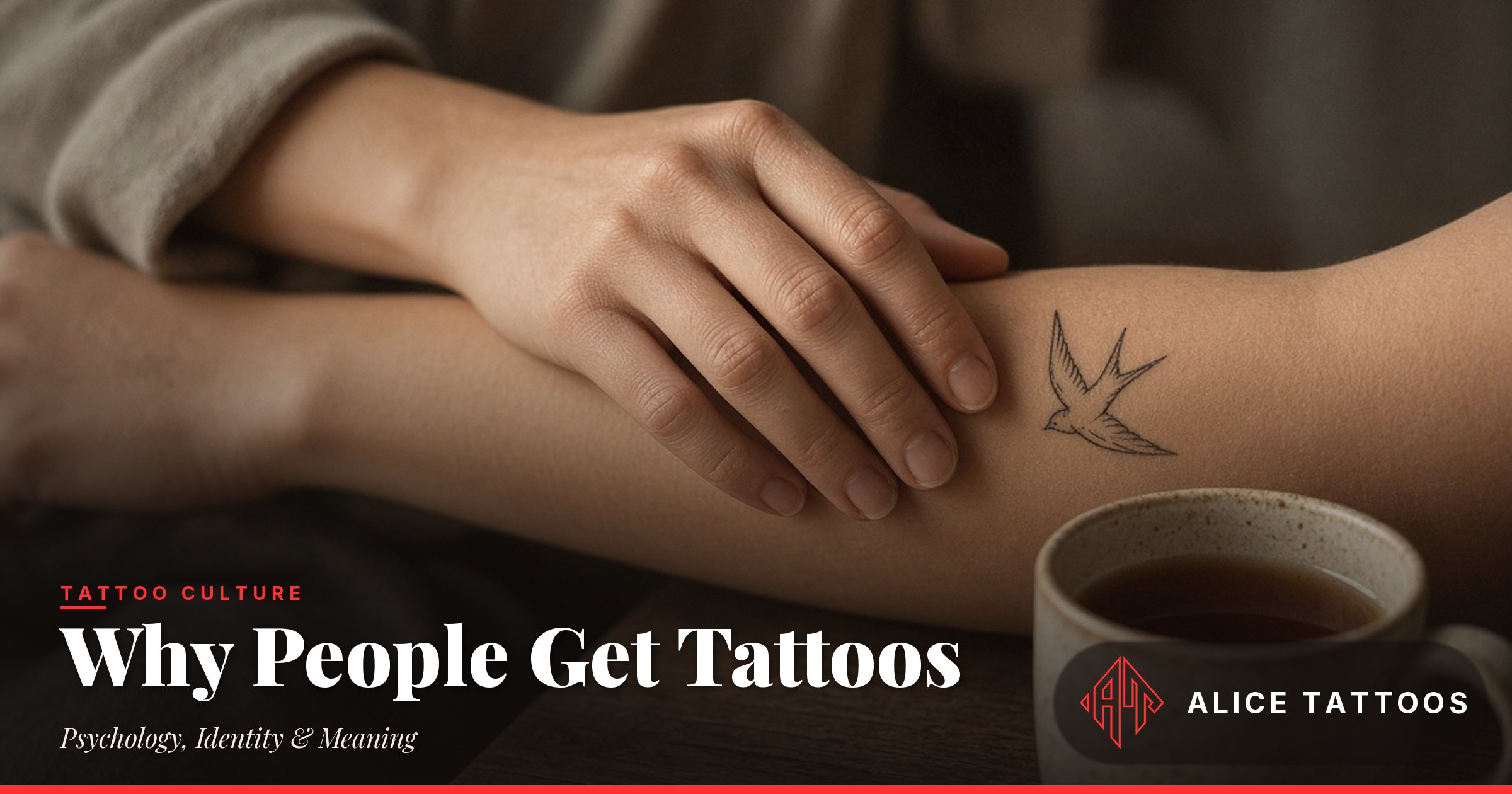
Short answer: people get tattooed for a handful of deep reasons — marking memory and milestones, expressing identity, belonging to a group or culture, reclaiming their body, and simply loving the art. Research consistently finds the strongest driver isn't rebellion or impulse: it's meaning-making — turning something internal into something visible and permanent. And for most people, it works: the majority of tattooed people say their tattoos strengthened their sense of self.
Key takeaways
- The big motivations: memory, identity, belonging, reclamation, aesthetics — usually several at once.
- Tattoos can be part of healing from grief or trauma, but they're a complement to care, not a substitute for it.
- Generational shift is real: tattoos went from counterculture markers to mainstream identity work in two generations.
- "Meaningful vs. just beautiful" is a false split — a tattoo you get purely because it's beautiful is a perfectly valid one.
The main reasons people get tattooed
| Motivation | What it looks like |
|---|---|
| Memory & milestones | Dates, portraits, tributes to people and pets, marking recoveries, births, losses |
| Identity | Saying something true about yourself that clothes can't — values, beliefs, who you are underneath |
| Belonging | Matching tattoos, family pieces, cultural marks, community symbols |
| Reclamation | Covering scars, reclaiming the body after illness, assault, or change — making skin yours again |
| Aesthetics | Pure love of the art form — collecting work you find beautiful |
| Rite of passage | Marking a transition — adulthood, a move, a survival, a version of you that ended |
Tattoos as therapy — what's real
The "tattoo therapy" framing has substance behind it. Research on tattooed populations links getting tattooed with improved body image and self-esteem, particularly for people reclaiming their bodies after trauma, illness, or major change. The act matters as much as the image: choosing to permanently mark yourself is a form of agency — literally authoring your own skin.
The honest caveat: a tattoo is a ritual and a marker, not a treatment. For grief, trauma, or mental health struggles it works best alongside actual care — the piece commemorates the healing rather than causing it. Framed that way, it's remarkably effective at what it does.
How the generations flipped
Two generations ago, a visible tattoo marked you as an outsider. Today roughly a third of adults under 50 have at least one — and the meaning flipped with the numbers. What grandparents read as rebellion, millennials and Gen Z read as self-authorship: the default assumption went from "what happened to you?" to "what does it mean to you?" That shift is why workplace acceptance kept climbing and why placement matters less socially every year.
For marginalized communities the calculation has always been different — for many, tattoos are identity made visible in a world that tries to erase it, which is precisely why they carry such weight.
Does a tattoo need a meaning?
No — and this is where people stall unnecessarily. "It has to mean something" is a recent expectation, not a tradition: sailors didn't agonize over the deeper significance of an anchor. A design you get purely because it's beautiful is complete as-is. Some of the best tattoos on collectors mean "I loved the way this looked" — and they regret them at no higher rate than the memorial pieces.
If you're on the fence about whether your idea is enough, the practical test isn't meaning — it's longevity: will you still want it in ten years? The first tattoo guide walks that decision, and the design studio is a low-commitment place to let an idea develop until it's obviously yes or obviously no.
If a tattoo already became a regret — that happens too, and there's a real playbook for it: cover-ups, removal, and moving forward.
Frequently asked questions
Why do people get tattoos?
The main drivers are memory and milestones, identity and self-expression, belonging, reclaiming the body after change or trauma, and aesthetics. Research consistently finds meaning-making — turning something internal into something permanent — is the strongest motive.
Do tattoos help with mental health?
They can support it: studies link tattooing with better body image and self-esteem, especially for people reclaiming their bodies. But a tattoo complements care rather than replacing it — it marks healing more than it creates it.
Is it okay to get a tattoo with no meaning?
Completely. The expectation that tattoos must be deeply meaningful is modern, not traditional. A piece you get because it's beautiful is a valid tattoo — meaning can also grow around it over the years.
Why did tattoos become so mainstream?
Generational turnover — tattooed millennials and Gen Z became the workers, parents, and managers. As the number of tattooed people climbed past a third of adults, the stigma math simply stopped working.
Do people regret meaningful tattoos less?
Not clearly — regret correlates more with the decision process (impulse, pressure, trend-chasing) than with whether the design "meant something". Thoughtful choice beats meaningful subject.